



I’m the founder, and I’m basically the brand. How do I build something bigger than me?
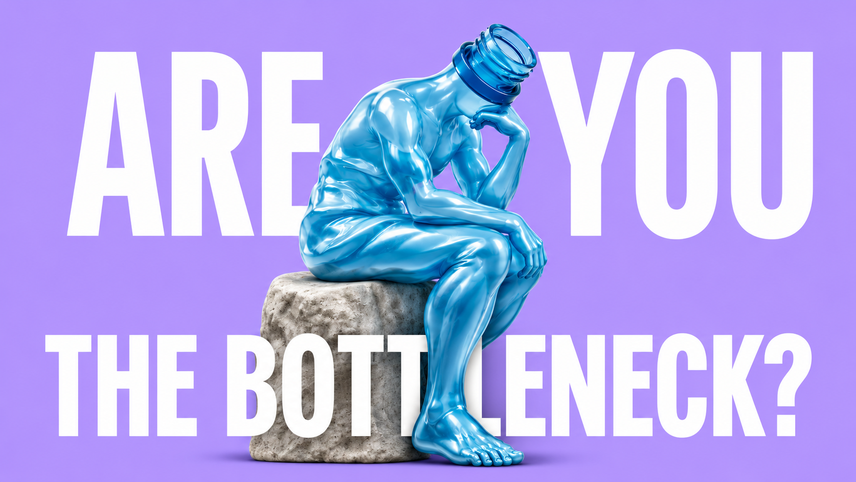
For the first couple of years, it’s normal for the founder to be the brand. That’s when the foundations are being laid, and someone has to hold them.
The real question is where you see it ending. If the brand ends with you, being the brand is fine. You can even put your name on the door. But if you imagine passing it on one day, to your children, a successor, your team, or whoever buys it over, then building something bigger than you means thinking ahead.
It starts with the people who represent the brand. They don’t need to think exactly like you, but they do need to think like you where it counts: embodying the brand and internalising its values. And you can’t define those values until you know what the brand is ultimately for. Know where you want to go, and you’ll know what you and everyone else need to be to get there.
It’s a bit like forming habits. Once those habits are replicated in everyone who works for the brand and with it, you have something scalable. Something bigger than you.
One more thing worth saying out loud. Being the founder doesn’t mean you’ll lead the brand forever, and that’s very much part of building something bigger than yourself. At some point you’ll need a leader who can carry the journey on your behalf. An inspiring vision and mission makes that person far easier to find.
Q. What parts of me should actually stay at the heart of the brand?
Your vision for the brand, and the values that get it there. Much of the rest of you can come and go as the brand grows. The vision and values are what should outlast you.
Q. How do I turn my personal instincts into something the team can understand and use?
Through values, and by consistently leading with them.
Defining brand values shouldn’t be a paper exercise. They have to be things you believe in and hold with conviction. If we don’t uphold them, and don’t reference them when making decisions about the brand or the company, they lose their meaning quickly. The team ends up confused, or worse, directionless.
I see brand values as the compass and, for the most part, the soul of the brand. Your instincts become usable the moment your team can see which value each of your decisions came from.
Q. What should the brand stand for beyond my own personality?
Its purpose. The why.
Why was the brand started in the first place? If you brought a product, a service, or even a job into the market, what was the higher reason behind it? Think of it as having a cause.
Founders often tell me they started their business to make money. Fair enough, but every business should make money. That’s the baseline, not the reason. So beyond your personality, and beyond the basics of turning a profit, find a cause people can rally around.
If people can’t rally around your brand, you’ll struggle to win customers, and you’ll struggle just as much to hire people to represent it. When both of those groups are hard to bring together, it becomes hard to keep the brand going over time.
Q. How do I make sure the brand still feels authentic as more people start representing it?
Keep reviewing your brand values against how people actually perceive you. The gap between the two tells you where dilution is creeping in.
You can’t fully control how a brand travels as it grows, but you can take care in how people are introduced to it. For employees, that means considering the entire journey, from how you get them interested enough to apply, through the interview, to onboarding. The people interviewing candidates need to represent the brand well themselves. Only then will the people they hire reflect the same qualities.
For brand ambassadors, give them the full brand experience across different touchpoints, and do it regularly. That’s how they learn to talk about the brand the way it wants to be spoken of.
Q. What systems do I need so every decision doesn’t have to come back to me?
Fewer than you’d think. A clear vision that sets firm direction, and a clear set of brand values that every decision is measured against.
When your team knows where the brand is going and what it stands for, most decisions can be made without you in the room. And when one does land back on your desk, it’s worth asking whether the vision or the values weren’t clear enough.
Q. How do I give my team enough freedom without the brand becoming inconsistent?
The same way. Vision and values are what make freedom safe.
When everyone steers by the same compass, people can take different routes and still arrive in the same place. Consistency comes from shared direction, not from signing off every detail. I call this brandshifting: stable at the core, fluid at the surface.
Q. When should other people start becoming visible voices of the brand?
These days, you don’t really get to choose the when. Your team, your customers and your partners are already talking about you, in their own words and on their own channels.
So the brand needs to take every opportunity to represent itself as accurately as it can, from the start. That way, whoever picks up the mantle can do it well from day one.
Q. How do I evolve the brand without losing the trust and familiarity I helped build?
This is where purpose and vision hold the brand together, even as it evolves with the times.
Say you run a tour company, and your purpose is to give people access to different places and spaces. If restrictions like those during COVID-19 stopped you taking people to tourist attractions, you could still offer tours virtually, or take people into entirely new kinds of spaces, like corporate or enterprise tours.
The offer changes. The purpose doesn’t. And the purpose is what people trusted in the first place.
Q. What should I personally keep owning as the founder, and what should I let go of?
Keep owning the beginning: the origin of the business and the brand’s journey. Let go of everything else, even if you stay on. That’s assuming, of course, that you want the brand to become bigger than you.
But letting go isn’t about giving up control altogether. Control still matters, up to the point of setting direction and giving guidance. Beyond that, letting go is about agility, and knowing how to respond. If you don’t bend, you break. Be bamboo. Be water.
Maybe “letting go” needs a better name. Something closer to responding in a way that keeps the brand alive, while staying true to what it was meant to be (purpose), do (mission) and become (vision).
Q. What does a healthy transition from founder-led to brand-led actually look like?
It looks like a team, or the brand’s representatives, moving with autonomy while staying true to the vision.
When good decisions get made without you, in a way you’d still recognise as yours, the brand has outgrown its founder. Which was the point all along.



Subscribe to get notified when new downloadables drop. Straight to your inbox.
Take it one step further. Book a free consultation with us and let’s talk strategy.