


_logo%201.svg)


Walk past a digital advertisement in a mall and most people will barely look up.
Put a timer on it. Add a challenge. Flash a score across the screen. Offer something to win. Suddenly, people are stopping. Someone is giving it a go. Their friends are filming. A queue is beginning to form. Even the person who said they were “just passing by” is now waiting for their turn.
That is the power of gamification marketing.
Different generations may respond to different mechanics. Younger audiences are comfortable with responsive screens, digital worlds and fast feedback. Older audiences may prefer something more familiar and straightforward.
But the instinct to play is not owned by any one age group.
Give people a clear challenge and a reason to participate, and curiosity tends to do the rest.
The brands winning attention today are not simply advertising to their audiences. They are giving them something to do.
What Is Gamification Marketing?
Gamification marketing applies elements commonly found in games to a brand experience.
These might include physical challenges, rewards or friendly competition. They can appear within apps and loyalty programmes, but they are becoming increasingly visible in physical brand activations too.
Think motion-sensing kiosks, interactive walls, mini-games, pop-up challenges and responsive installations in malls, festivals and other high-traffic spaces.
Instead of asking someone to watch an advertisement, the brand gives them a role inside the experience.
This changes the relationship immediately.
When something feels like a game rather than a sales pitch, people are more willing to lower their guard. They are not being spoken at. They are being invited in.
Research into gamification marketing has linked well-designed game mechanics with emotional, cognitive, social and behavioural brand engagement. The important part, however, is that the game must feel relevant to the audience and the experience.
Four Brands That Turned Marketing Into Play
#1 McDonald’s x Hershey’s Made People Scream for Ice Cream

At Funan Mall, McDonald’s Singapore and Hershey’s created an activation with one extremely simple instruction: scream.
A sound-responsive screen measured the volume of each participant’s voice. As the decibel level increased, an on-screen vanilla cone transformed into a Hershey’s cone. Reach the target and you receive a voucher for a free ice cream.
The three-day activation gave away 1,200 cones. More importantly, it created a spectacle that people could understand from several metres away. There was no complicated registration journey or lengthy explanation. You screamed. You won. Everyone nearby watched.
That simplicity mattered. The audience did not need to be convinced to engage because the mechanic explained itself.
#2 Coca-Cola Made Recycling Feel Like an Arcade Game
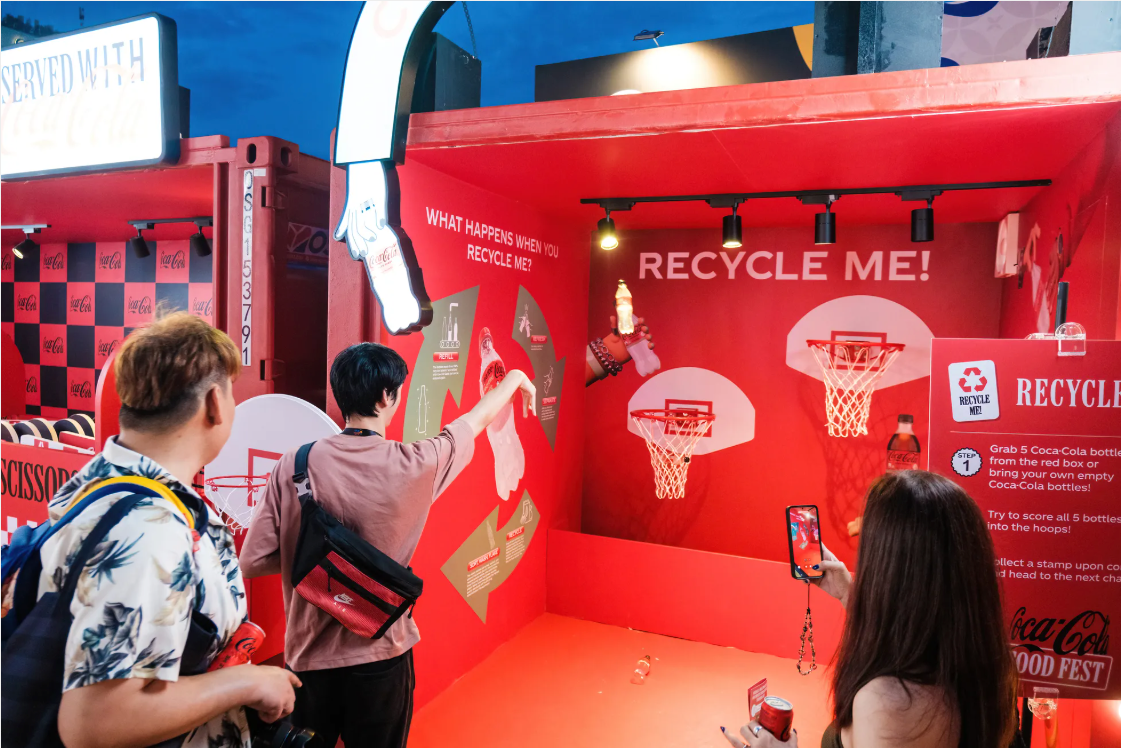
At GastroBeats 2024, Coca-Cola’s activation included an arcade-inspired recycling challenge that invited participants to throw empty bottles through basketball hoops.
To complete the activity, players had to earn five points. What could have been another corporate recycling message became a physical challenge with a clear goal and immediate sense of achievement.
Coca-Cola did not place itself at the festival as something people merely walked past. It gave festival-goers a reason to stop, interact and associate the brand with the energy of the event.
That is the difference between appearing at an experience and becoming part of it.
#3 Singtel Turned Scam Awareness Into a Challenge
Scam education is important. But it is also very easy to turn into a wall of warnings that nobody wants to read.
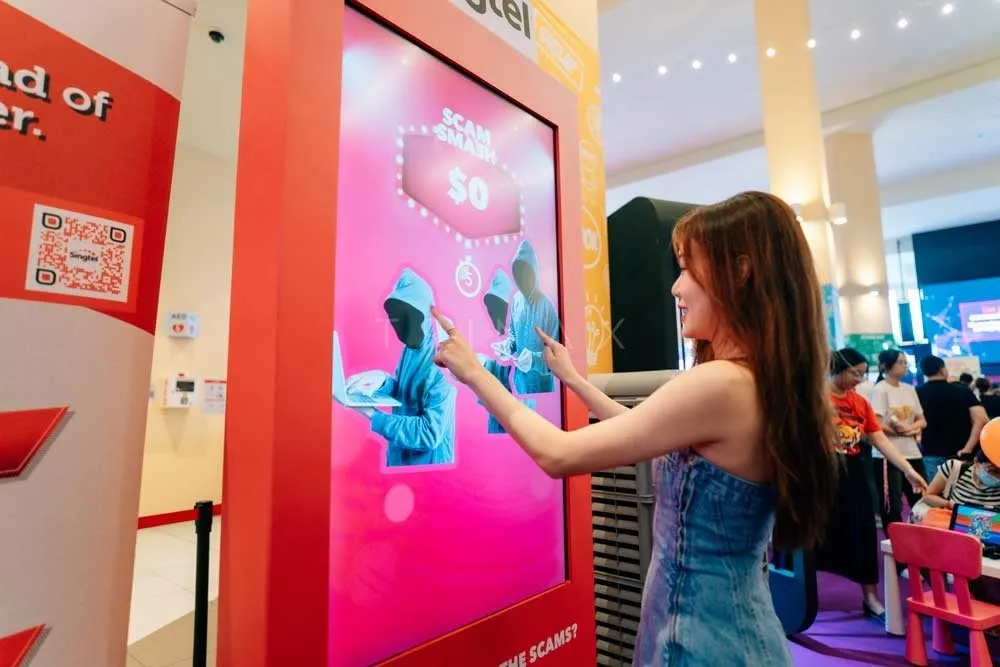
Singtel’s Scam Smash experience at the Digital for Life Festival took another route. Participants worked through simulated phone calls, emails and messages, looking for suspicious clues and deciding whether each scenario was a scam. A reaction challenge then asked them to tap as many scammers as possible within 15 seconds.
The game turned abstract advice into active decision-making.
Instead of telling participants to stay alert, it lets them practise being alert. That makes the lesson more immediate, more accessible and much easier to remember.
#4 HPB Made Movement the Price of Admission
The Health Promotion Board’s Nutri-Grade vending machine outside Jurong East MRT Station asked commuters to “pay” for a drink with squats.
The number of squats depended on the beverage selected. A Nutri-Grade A drink required just three, while less healthy options required considerably more. After participants completed the challenge, the machine dispensed their reward.
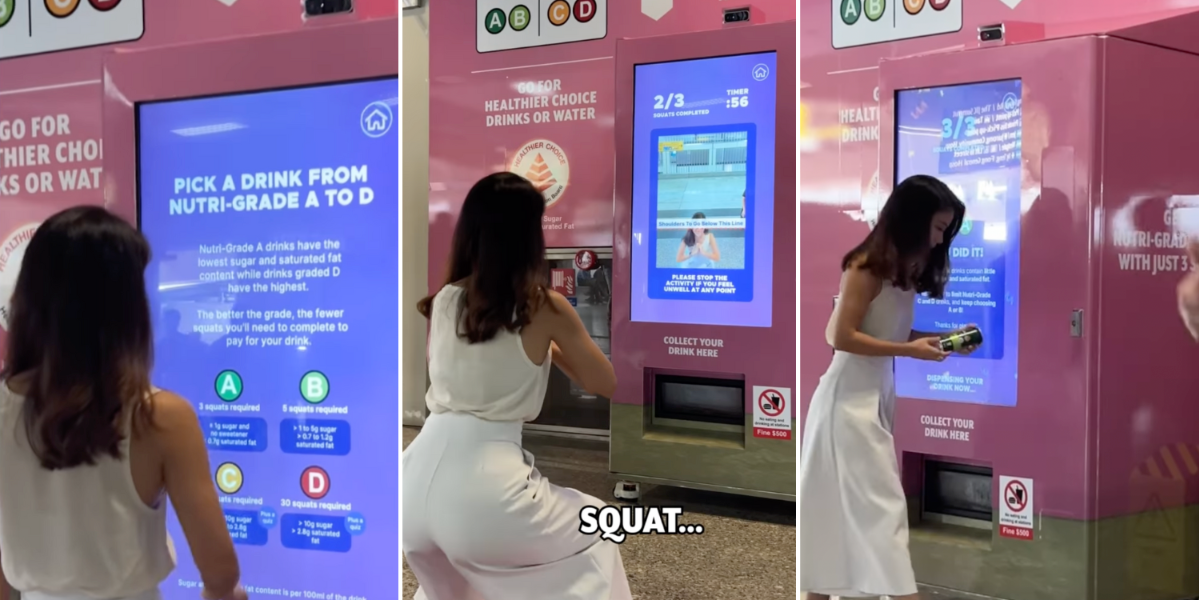
It worked because the interaction embodied the message.
HPB did not simply tell people to make healthier choices and move more. It turned both ideas into one playful action.
The mechanic was not a decoration added to the campaign. It was the campaign.
Why Play Works When Advertising Does Not
Most advertisements begin by demanding attention.
Games earn it.
A visible score creates curiosity. A countdown creates urgency. Progress encourages someone to keep going. A reward gives the action a satisfying conclusion. Competition brings friends and strangers into the experience, while spectators create energy around it.
The participant is no longer a passive target. They become the player, performer and, increasingly, the person creating the campaign’s next piece of social content.
That does not mean every activation needs a giant LED wall, virtual reality headset or highly complex game engine.
Technology can make an experience more responsive, scalable and measurable. But the mechanic still matters more than the machinery.
If someone needs a five-minute briefing before they can play, the game is probably doing too much. The best activations are often understood almost instantly: kick the ball, spot the scam, complete the squats, beat the score.
Clear action. Clear feedback. Clear reward.
Where Gamification Marketing Is Going Next
As motion tracking, AI and immersive technology become more accessible, the gap between physical and digital experiences will continue to shrink.
A booth can adjust its difficulty based on the participant. Rewards can change according to performance. Scores can appear on shared leaderboards in real time. A physical game can continue on a mobile device after the event has ended.
But more technology will not automatically produce more engagement.
Poorly designed gamification can create fatigue, confusion or frustration, especially when the competition feels forced or the reward has little connection to the effort required. Research consistently points back to the same principle: the experience must be thoughtfully designed around the people playing it.
The future is not about adding a game to every campaign.
It is about recognising when participation can communicate an idea better than another poster, video or product display ever could.
The Brands People Remember Are the Ones They Joined
The strongest brands today are not always the ones making the most noise. They are the ones creating moments people choose to enter.
Because marketing becomes more memorable when the audience has a part to play in it. They moved. They competed. They laughed. They won something. They pulled out their phones and told someone else to try. They were not simply exposed to the campaign.
They were inside it.
At LLUMO, Superminted’s Playful Marketing arm, we turn brand objectives into interactive games, challenges and experiences that get audiences moving, learning and participating. Want to build marketing people do not just see but choose to be part of? We’re ready when you are!



Subscribe to get notified when new downloadables drop. Straight to your inbox.
Take it one step further. Book a free consultation with us and let’s talk strategy.
.svg)


